|
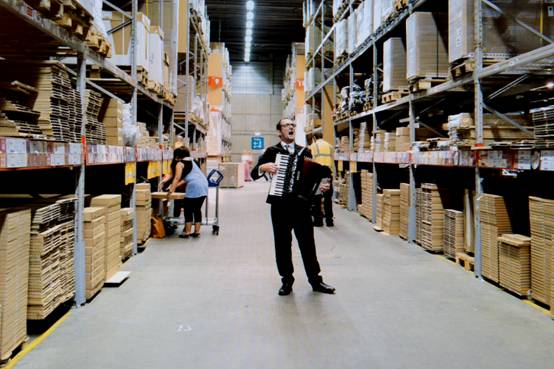
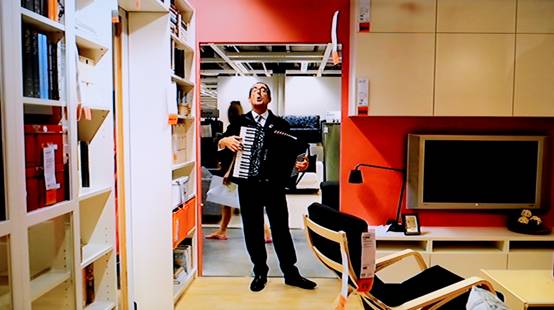
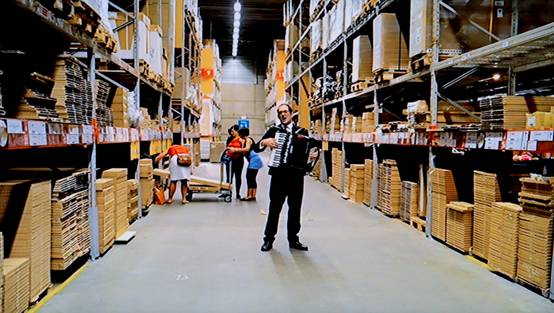
Welcome to the undertaker of the old ways and the dancemaster of the new social Phil Moody's recent work at Dean Clough arts centre in Halifax (UK) includes a video of him singing the names of Ikea products, in Ikea, in a suit, whilst playing the accordian.
On one level, this recalls dadaism and sound poetry: 'Kivik' arrives already sounding like a lettrist piece, and Hugo Ball’s 'Karawane' now sounds like a set of bookshelves. It is perhaps no surprise that Marie Osmond performed 'Karawane', written in 1916, on Ripley's Believe It Or Not, in the mid-1980s. Her face could be found in many expanding suburbs during that period, and so perhaps we shall live to witness the arrival of the Blago Bung wastebasket. Apparently, one Ikea ‘technique’ is called ‘bulla bulla’, and refers to the act of filling retail bins with ‘stuff’ to make it look like more of a bargain: Some Ikea words have ‘real meanings’, but few of them have a direct or reciprocal relationship with the products they name. But this piece isn't a simple riff on dadaist sound poetry. The suit Phil wears, in the context he places it, could be the suit of an entertainer, or of a sales rep. Its meaning slips, but along with the accordian, it also signifies the 'respectable peasant' of Berger and Mohr's Seventh Man. In turn, the landscapes of eastern Europe, invoked by Bartok, rise unbidden to the surface of the comedy, at the same time as they never fully arrive. Phil processes the performative gestures of an earlier kind of showmanship, his head rolls, his eyes close and open during the rollercoaster dip, indicating gravity, tragedy even, and let us not forget that the people who would become ‘the dadaists’ returned from the first machine war in Europe unable to speak straightforwardly. It is almost needless to explain that trying to re-inscribe something like 'authenticity' by singing the names of Ikea products in the banal, homogeneous spaces where they are sold creates an absurd situation, but this 'folksy' performance, within the massive corporate anonymity, is a prism, it is a complex: This is not a simple or simplistic piece of work at all. This work, for me, is properly dialectical, in Hegel's sense of 'aufheben', in that it shuttles the viewer through a large and contradictory set of questions, without ever fully solving those contradictions. The work, conceptually, when given enough time of attention, yields a mosaic-like structure.
There is great humour in the group of women negotiating a flat pack out of a bay in the warehouse, as Phil sings and plays in the foreground, but there is a real pathos under the neo-dadaist fun here too. The quotidian is imbued with a kind of deep sadness, all the more acute because it really is a pathos, a cultural inevitability which must be endured for entire lifetimes - and therefore infinitely - and no declarations of alterity can stop this: The act of performing authenticity in Ikea is like standing in front of a blind, oncoming bulldozer. In this, again, there is a dialectical tension between the humour and the heavy critique, the two never settle, they writhe constantly under the surface of one whole reality. If Phil seems to be plumbing the depths of national tragedy in Ikea, what might this be an unconscious mourning for? The loss of 'the authentic?' Here lies Bauman's idea that the current, feverish declarations of authenticity, localism and community - as well as the rising paradigm of nationalism - are symptoms, symbolic acts of mourning for a lost stability, understandable borders and quaint things like 'belonging'. Yet at some point, when viewing this piece, tragedy and farce become entwined, and here is the place where we begin to move into the other side of the dialectical process. Phil's solemn declarations of these almost empty signifiers also sounds like a change of steps being declared at a village dance, something which is so fundamentally of the social world: 'Kivik' could easily prefigure a shift to a 'Do-si-do'. Yet the words do ultimately relate, at best, to boring objects, there are no dancers, the music only choreographs shoppers in progress. But how appropriate, actually, because after Marx and Debord, 'the social' in this world of markets-within-markets, is negotiated through objects. To think through this further, we might look to Daniel Miller, whose anthropological research has tried to erode the assumption that houses filled with objects are instantly 'bourgeois', and that if the social is now negotiated through such objects, then a relativist view of a rich social life might actually have a lot of objects in it, and an impoverished one very few. This point is made very strongly at the start of Miller's 2008 book, The Comfort of Things. For that other major philosopher of 'stuff', Bruno Latour, objects have agency, they are players, as much as people, and Phil has explored this theme in many of his other pieces. Viewing this work through Latour and Miller’s eyes, we might now see Phil as a kind of dancemaster of the new social, as well as the undertaker of 'the old ways', or the town cryer of the corporate sell-out. Because actually, we make the world via Ikea each day, and processes like them, globally, and this may be unimaginative, but it is undeniably anthropological. What, in fact, is more 'of our time' than shopping in Ikea? Is it not as historical, in its own way, as photographing dead Victorian children? In terms of an anthropology and history of the present, ultimately, it could be argued that shopping in Ikea is as 'authentic' as trading shells on heroic boat journeys through island archipelagos. This is what great art does, it engages you in an immediate and entertaining way, but, depending on what you bring to it, it also opens out like a fan, it holds - as the F. Scott Fitzgerald cliché runs - two contradictory arguments within itself. This work also revisits art history in homage, here by re-invoking the now impossible radicalism of sound poetry, and the author is also 'in' the work to a greater or lesser degree, as Kippenberger was in his Dear Painter Paint For Me series, despite also trying to airbrush himself out of the process via a deliberate immersion in the world of commerce. In this, Phil's work has an equally dialectical relationship to postmodernism too, as the pieces do not simply revel in an endless series of 'situations', their authenticity emptied into a plunge pool of free-floating signification. This work is trying to impossibly root itself on a postmodern economic landscape which still shows no sign of slowing down, and despite its fundamentally double-edged nature, in this it also simply provides us with a picture of the world anywhere outside the gallery at this time, which is more 'real' in its own way than more direct forms of representation such as photography: In this, finally, it is very rich and rewarding art.
Steve Hanson is a writer currently living in the
north of England. He accepts all overseas residencies. Contact
nevetsnosnah@gmail.com. Photos by permission of Phil Moody.
|