
M.
L. Weber
work in progress:
Notes after Rilke's Duino Elegies
I.
1.
Rilke begins: ". . . if I cry out, will any angel hear me?"
But even if angels exist, even if one turns
and watches you—
as we would like to think they do—
say a particular angel, say a young man, watches me
as a constant companion—a sympathetic young man—
one who resembles myself as a boy
(we need our angels to have a face)
if this congenial angel heard my thoughts,
"if my cry was taken up
and I was pressed against his heart,
I would perish in that force of existence—
Beauty then is but the threshold
of such a reality we could not well endure. . . . "
(for Rilke saw angels as glorious beings,
and imagined that he would
perish in such beauty
should an angel ever show himself)
But angels or gods or spirits do not awe us today—
they are referred to in the popular mythology
as something just beyond the present technology,
"pure energy beings," used as plot devices—
"Who then can we turn to?
Neither angel nor human.
The animals with their cunning can sense we are not at home here.
We grasp only a portion of their world. . . .
For us, we remember only
a tree outlined on a hill or a walk taken yesterday. . . . "
Neither angel or human to guide us, but now machines
to cut through the fog of human distraction
to store our memories without emotion,
or useless detail of worry,
if any detail is worthless,
though from the view of efficiency most of what a human does
to breath, to eat, to care
to form a habit like settling in before sleep with the newest novel
is a waste of time.
Artificial thought is the new angelic order
and will look up at the night sky
only to plot a position—
no constellations will appear
in such a mind-form
nor will they truly understand as an angel would
"in the night, when the wind
of the world's infinite presence
erodes away every face"
until the faces are only numbers
"Angels do not know the living from the dead.
An eternal storm runs through both past and present,
a torrent through all the varieties of time"
from which we divorce ourselves
while the angels we lately imagine
long for human life,
long to sit in the dust of the earth
and let it collect
on their wings,
to become hungry,
to see wrinkles form in the mirror.
We think they envy us our ordinary lives
and simple pleasures
though pain and the fear of pain stops us from
not desiring their immortality
2.
“Lovers die forever
as Nature—exhausted—
cannot recreate them. . . .”
remember a lover strongly enough and say,
“’Perhaps I could become like her.’
Is it not time this ancient suffering come to fruition?
Is it not time we lovingly free ourselves from lovers
and tremblingly endure, like an arrow,
the tension of the bowstring
until, in flight, it transcends itself.
For we can rest nowhere.”
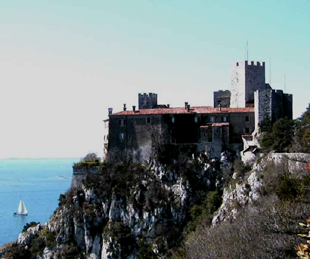
Duino Castle like a prison
enclosed on a strip of land
between “sea and stone” he said
as he also was imprisoned
in the tower
in his research for love beyond love
time stalls in a back water port
no one comes to,
a triste place of faded vines near Trieste
where famous exiles once drank coffee
and wine, where I dried out on a concrete quay,
staying a full season of hell in a town
which James Joyce claimed ate his liver.
Land fought over, coveted,
almost a million dead
no longer thought of
the populace aging
jobs for immigrants elsewhere
the rain falling in Trieste
after a dry springtime
soaks into
underground rivers never to be seen
again until reaching the sea
descending like an old man
from the bus
one last leap
to the pavement
how many more
“Unreal to die, to lose
a life you haven’t yet even learned to live,
to see roses and the like
in non-human terms,
no longer in a loving embrace
as parents hold a child,
to love the precious first name they gave you . . .”
while the rain falls
desultory drop after drop
like a salve on the dark soil
a symbol, yes,
a hope against hope
soaking away the pain
leeching away minerals
captured furtively by the grape roots
to produce a thick wine
red-black like drying blood
drunk by the Slovene minority
in the karst plateau above
who have a long history
of conflict
where the sea curves
around to Venice
and Asia creeps into Europe
shop signs in Slovene
their alphabet drops the vowels
Trieste becomes Trst
World War I
ate them alive
the next war
brought the false alliance of Yugoslavs
but Trieste was seceded
in the power balance
so a minority holds on
their language
unofficial
Trieste a finger into the eye
or down the throat of Trst
the harbor sitting like a mouth
on the face of Slovenia
3.
“Unreal to die, to lose
a life you haven’t yet even learned to live,
to see roses and the like
in non-human terms,
no longer in a loving embrace
as parents hold a child,
to love the precious first name they gave you . . .”
4.
“Voices. Voices. Listen, my heart. . . .”
as the dead haunt us
and the dead to come
“. . . perhaps you could attend
to the silence where in the slight wind
as a murmur . . .”
as the art of children is filled with death
they are taught war
that death in war by the enemy is deserved
and for our own to die is honor
except when we notice children have died
when covered by the news with fresh graphics
then we get uncomfortable
and so switch our minds elsewhere
but if our own children die
then we see the pictures
repeated for years
and the commercials for votes remind us
fear brought home so we cheer for revenge
and find all warriors' courage inspiring
for a "war-like people"
as a think-tank
proudly described Americans
". . . a murmur growing from a silence,
in a slight wind,
from those who died too-soon—
as you walked in a church in Naples or Rome—
did they not come quietly to address you?"
II.
"Every angel, a terror—
yet knowing this, I call you down,
almost lethal bird of the soul. . . .
Who are you?"
What are we to dream of you?
As of mountains without stain
pure in the distance
promise of peace
yet we walk in them talking of the city
in heaven we would talk of gossip
hold up mirrors
"which gather up beauty"
from a beautiful face, a beauty
most easily found
but inspiring poetry in a Hapsburg castle
and if all the angels are beautiful
whose face do you choose
Angels must have control
as they have tasks
spiritual work
they have radiance, beauty, invulnerability,
power
and since they live in heaven—
entering into the fantasy of angels—
we must say
they have these attributes—
construct the world of angels,
the time of angels,
the minds of angels—
or go back to earth
and live in a fantasy
a little more real
say a dinner at a restaurant,
someone else cooks, you command
self-satisfied, pot-bellied toad you eat
like a hungry ghost
your mouth a vacuous hole
through which stream
mounds of denuded paradise—
rainforest nuts, chocolate, rich spices,
the most expensive olive oil,
massaged beef
and sitting back you quote Shakespeare
or Rilke better yet
M. L. Weber is the editor of Sugar Mule. For more info click here.
